
Author: Konstantin Sakharov | Director - Operations and Business Development
So, you’ve landed your dream job, survived the mountain of initial paperwork, and realized that Dubai’s summer heat can feel like standing on the surface of the sun. Now comes the biggest challenge of all: finding a place to call home.
While Dubai’s rental market is highly regulated and safe, it operates with its own unique set of rules that can surprise even the most seasoned traveler. Before you sign a one-year lease, here is everything you need to know to navigate the process like a local.
While Dubai’s rental market is highly regulated and safe, it operates with its own unique set of rules that can surprise even the most seasoned traveler. Before you sign a one-year lease, here is everything you need to know to navigate the process like a local.
1. The "Test Drive" Strategy
The biggest mistake many newcomers make is rushing into a long-term commitment within days of landing. Dubai is a city of distinct "vibes" - what works for a socialite in Dubai Marina might not work for a family in Motor City or a professional in Business Bay.
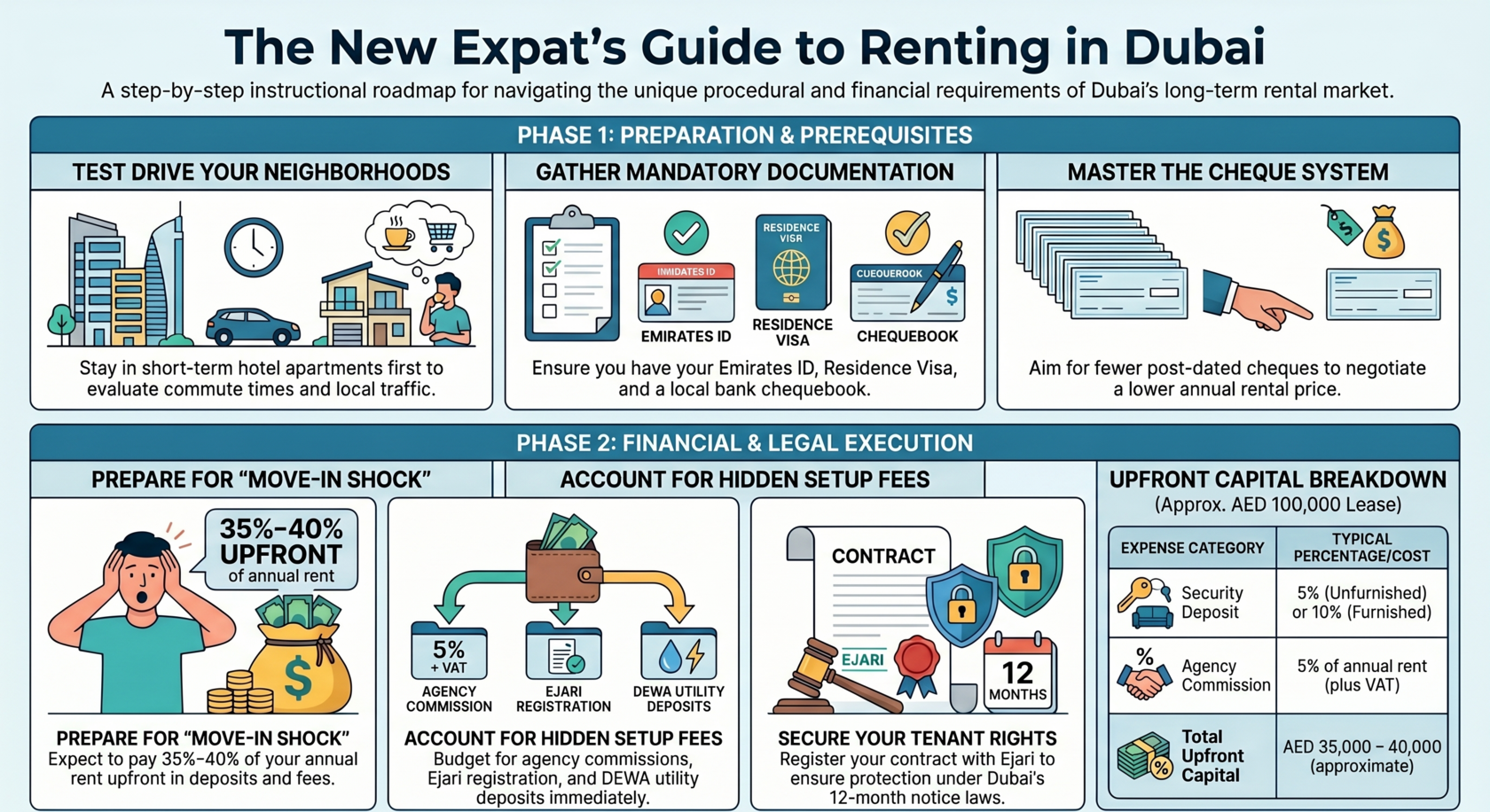
Before committing to a year-long contract, treat your first few weeks as a "test drive". Stay in a hotel or a serviced apartment and explore areas like JLT, JVC, Downtown, or Discovery Gardens. Use this time to evaluate your commute, local traffic conditions, metro access, and proximity to supermarkets. You may even find that renting a car is critical for your specific daily route.
Before committing to a year-long contract, treat your first few weeks as a "test drive". Stay in a hotel or a serviced apartment and explore areas like JLT, JVC, Downtown, or Discovery Gardens. Use this time to evaluate your commute, local traffic conditions, metro access, and proximity to supermarkets. You may even find that renting a car is critical for your specific daily route.
2. Get Your Paperwork in Order
You cannot simply walk into an apartment and rent it on the spot. To sign a legal tenancy contract, most landlords and property managers will require:
- A Residence Visa and Emirates ID
- A Labour Card (where applicable)
- A Local Bank Account and Cheque Book
3. The Power of the Cheque
In Dubai, the "cheque system" is king. Unlike many countries where you pay monthly, Dubai landlords generally expect rent to be paid via post-dated cheques.
The number of cheques you provide can significantly impact your rent price:
The number of cheques you provide can significantly impact your rent price:
- 1 Cheque: Usually secures the best possible price.
- 2 to 4 Cheques: The most common arrangement, though 4 cheques may see a slight increase in rent.
- 6 to 12 Cheques: Possible with some landlords, but typically much more expensive
4. Preparing for "Move-In Shock"
Many expats expect to need a small deposit to move in, but Dubai’s upfront costs are substantial. If you are renting an apartment for AED 100,000 per year, you should realistically have AED 35,000–40,000 available immediately.
Your initial costs will include:
Your initial costs will include:
- Security Deposit: 5% for unfurnished or 10% for furnished properties.
- Agency Commission: Typically 5% of the annual rent plus VAT.
- Ejari Registration: A mandatory government registration fee for your contract.
- Utilities (DEWA): A security deposit is required for electricity and water.
- Chiller & Gas: Many buildings require separate activation fees and deposits for cooling and gas services.
- Internet/TV: Be prepared for annual or monthly contract fees.
5. Know Your Rights
The good news is that Dubai offers some of the strongest tenant protections in the region. Your contract is registered with the Dubai Land Department, and landlords cannot simply evict you on a whim. Even if the property is sold, the new owner usually inherits your existing agreement. In most cases, if a landlord wants the property back for legal reasons, they must provide 12 months' legal notice.
6. Is Long-Term Always Better?
Interestingly, once you factor in deposits, utility costs, agency fees, and maintenance, a one-year lease isn't always significantly cheaper than a serviced hotel apartment—especially for those only staying a few months. Dubai rewards long-term commitments; you will find better rates for everything from internet packages and gym memberships to car rentals if you sign for a full year.
Final Thoughts
Dubai is a city where planning ahead is financially rewarded. Don't fall in love with the first apartment you see—in this market, there will always be another one five minutes later.
Coming Next: Stay tuned for our deep dive into "Hotel Apartments vs. Long-Term Rentals," where we break down the real numbers to see which option actually saves you more money.
Coming Next: Stay tuned for our deep dive into "Hotel Apartments vs. Long-Term Rentals," where we break down the real numbers to see which option actually saves you more money.